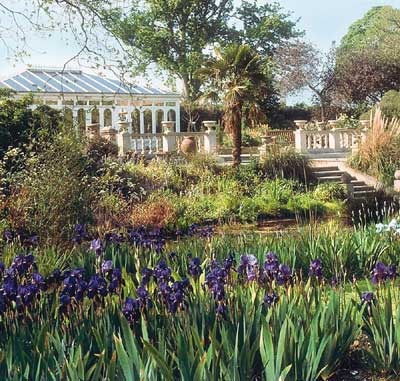
There is a small plot in the Royal Horticultural Garden at Wisley called Bowles’ Corner, dedicated to E.A. Bowles, Edward Augustus Bowles, 1865-1954. He was born in Myddelton House in Enfield, lived there all his life and became a well known horticulturalist and plantsman. He was elected to the RHS Council in 1908, became Vice President in 1926 and was active in the RHS until he died.
He wrote three books still in print, My Garden in Spring, My Garden in Summer and My Garden in Autumn and Winter. The books provide detailed observations of the plants in the gardens he created around Myddelton House, one of the most unexpected gardens I have ever visited. Unexpected because it is in the middle of suburban Enfield.
And unexpected because it contains for instance, a patch called The Lunatic Asylum, a bridge over a grass walk and the old Enfield Market Cross in the middle of the rose garden. And I had to look twice before I decided yes, that is a clump of Japanese Knot Weed - a banned, pernicious and invasive alien weed.
The Lunatic Asylum
To say that Bowles was interested in plants is an understatement. One of his passions was for plants that had unusual growth forms, such as the corkscrew Hazel that is still grown today. He collected them and planted them in the area he called the Lunatic Asylum. He included, for instance an unusually spiny holly and a pine with warped growth. And other gardeners sent him their contorted plants to include in the plot.
The Bridge and The Enfield Market Cross
The grass walk in the centre of the garden was a river in Bowles’ lifetime, yes, an actual river that divided his garden … the New River which brought water from Ware to London; hence the bridge which still remains though the river was filled in during the 1960s.
And the Market Cross is in the rose garden where Bowles put it when he rescued it from a salvage yard!
The Japanese Knot Weed?
Bowles admired its architectural qualities at a time when its invasive nature was yet to be recognised. It is kept now to enable people to identify it, and also to show how it can be contained.
As well as these and other unusual features, there is a beautiful pond, rock garden, kitchen garden, terrace, alpine meadow, Victorian Glasshouse, many borders including Tom Tiddler’s Ground (!), a museum and cafe. Bowles was particularly interested in crocuses, colchicums and snowdrops, as well as succulents and cacti. Winter may seem an unusual time to visit a garden but not when it is to see crocuses and snowdrops, of which there are many in this garden, including the National Collection of Crocuses.
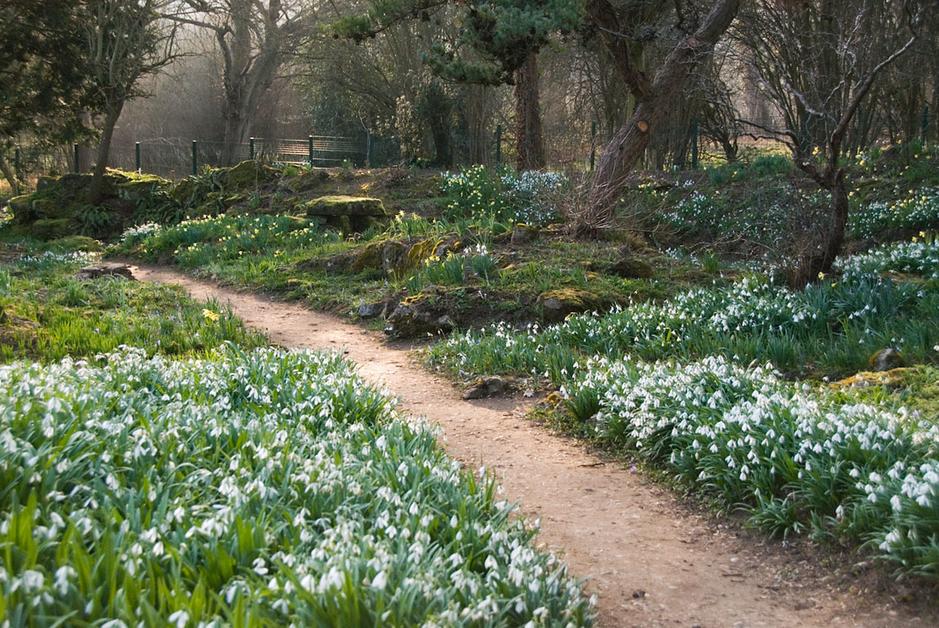
There is also an Annual Snowdrop Fair, this year on January 25th. And don’t miss the succulents and cacti in the glasshouse. Bowles was not just a gardener but a renowned horticulturalist. He was responsible for naming many plants, and many others are named after him, like Bowles’ Golden Grass and the wallflower Bowles’s Mauve.
The garden is open all year round, is free to visit but you have to pay for parking. It was left to London University after Bowles’ death and is now run by the Lee Valley Regional Parks Authority. There is no website but you can find information on the Lee Valley website (including more on the Snowdrop Fair), on the E.A. Bowles Society website and on Wikipedia.
There is also a fascinating article in The Londonist on line. Just type in ‘Myddelton House in The Londonist’ on Google..