| Status: | Active, open to new members |
| Contact: | |
| When: | Weekly on Monday afternoons 1.30pm to 4.00pm in Winter. 2.00pm to 4.30pm in Summer. |
| Venue: | Members Home |
| Cost: | None |
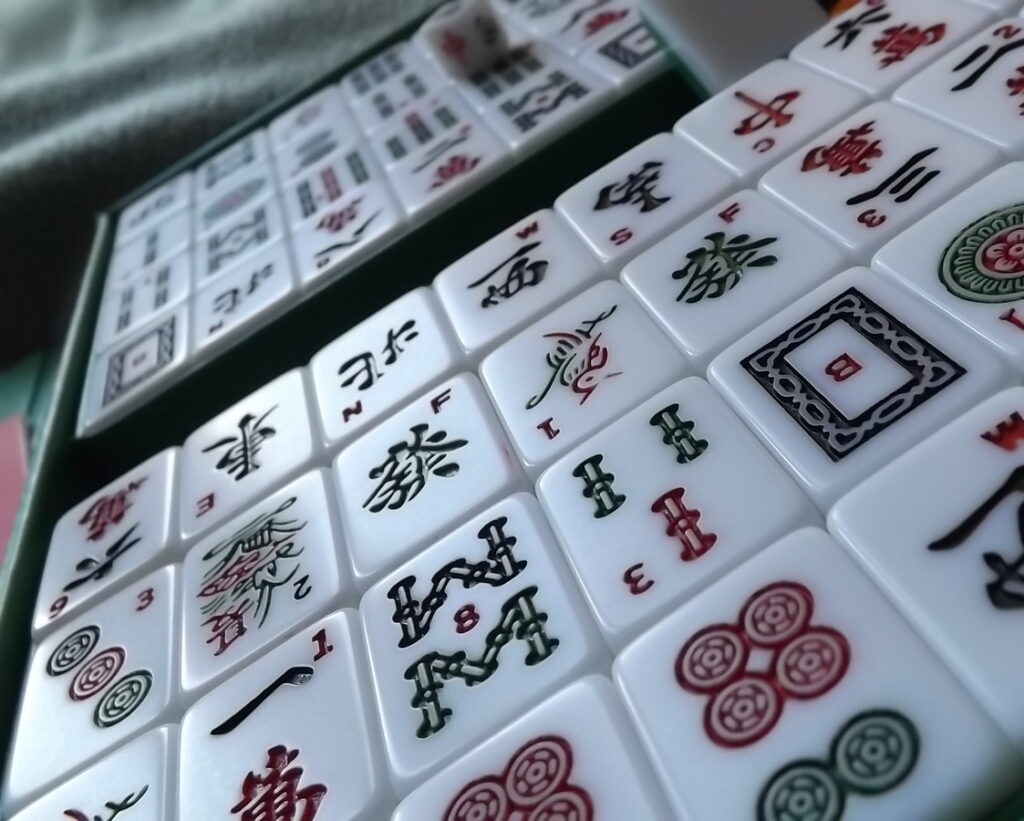
Mah Jong may appear to be a complicated game but it is really very easy to learn and you can quickly become proficient at playing the basic game.
You don’t need to own a Mah Jong set as we have plenty of sets available within the group.
Why not come along and try this fascinating game?
Our focus is on playing in a relaxed and friendly atmosphere with a cup of tea or coffee to aid the play.
We are a small group so we meet in a member’s home.
If you would like to join the group or would like to come along for a taster session, please contact the Group Contact above.
Mahjong: A Game of Skill, Strategy, and Tradition
Mahjong is a centuries-old Chinese tile-based game that combines skill, strategy, and luck. In fact, Manjong is similar in principle to Rummy.
Traditionally played by four players, the game uses a set of 144 tiles based on Chinese characters and symbols, although regional variations exist. The objective is to build a winning hand, often referred to as a “Mahjong,” by drawing and discarding tiles while forming specific sets, such as pairs, sequences, or triplets. The tiles consist of three suits (Bamboos, Characters and Circles) as well as special tiles (Dragons, Winds, Flowers and Seasons).
The origins of Mahjong trace back to the Qing Dynasty, and it has since become a cultural staple in many East Asian countries, as well as among global communities. Over the years, Mahjong has evolved into various regional styles, including Chinese Classical, Hong Kong, Taiwanese, and Japanese Riichi Mahjong, each with unique rules and scoring systems.
Mahjong is more than just a game; it is a social and cultural activity that fosters community and connection. Traditionally played during family gatherings and festivals, it brings people together, encouraging interaction and camaraderie. For many, it is also a symbol of tradition and continuity, passed down through generations.
Beyond its entertainment value, Mahjong offers numerous cognitive and health benefits. The game requires players to remember tiles, calculate probabilities, and devise strategies, which can enhance memory, focus, and decision-making skills. Studies suggest that regular Mahjong play may even help delay cognitive decline and improve mental acuity in older adults. Additionally, the tactile handling of tiles promotes fine motor skills and hand-eye coordination.
In modern times, Mahjong has gained global popularity, with tournaments and online platforms introducing the game to new audiences. Its enduring appeal lies in its ability to blend mental challenge, social interaction, and cultural richness, making Mahjong a timeless pastime enjoyed by millions worldwide.