| Status: | Active, open to new members |
| Contact: | |
| When: | Monthly on Friday mornings 4th Friday of the month. 10:00am - 12:00pm. |
| Venue: | Odiham and Greywell Cricket Club |
| Cost: | £20.00 per year |

Everything we do has an effect on our environment, and it is now well established that the world is going through a significant change of climate, mostly caused by human activity. The objective of this group is to help members more fully understand what the issues are, and how we can through our own actions, and through informing others, both improve the environment around us and help to mitigate the effects and adapt to the changes caused by the climate emergency.
Each month we will concentrate on a relevant aspect with subjects being introduced by members or guest speakers.
Whilst this is an important and topical subject, we wish the discussions to be open and supportive rather than confrontational, with everyone encouraged to participate as much or a little as they wish.
Members can visit our microsite to view details of our meetings and to access a wide range of resources for members, including: the latest climate news; climate science; energy and CO2 mitigation technologies and much more.
We welcome new members to our discussions whatever their knowledge of the subject.
If you would like to contact the group by email click on the Group Contact above.
Go back to exploring all of our groups here.
Environment and Climate Change Group
Meeting Highlights - April, May and June 2026
Our vibrant and enthusiastic group has been busy recently. A select team have been promoting the national campaign to raise awareness of the National Peoples Briefing which highlights the complex issues associated with Climate Change. We have explored and discussed a range of issues including new and novel ideas. Lastly, if you are curious about the issues we face locally, nationally and globally, we have included some links to websites for you to discover more. And of course, there is the Environment and Climate Change Microsite which contains a wealth of relevant information.
National Emergency Briefing
Members of the Environment and Climate Change group have been active in organising local public showings of the National Emergency Briefing film and then facilitating discussions about the very real issues we are all facing as a consequence of Climate Change.
This is an excerpt from the NEB June Statement:
" .....‘Chris Packham’s Petition reached 10,000 on 20th May triggering a formal government response
Government responded to this petition. 15th June
We recognise the growing risks from climate and nature breakdown, and are committed to speaking clearly about the scale of the crisis and providing reliable sources for information and advice.
The UK government recognises the growing risks from climate and nature breakdown. Nature and a stable climate underpin our health, economy, national security and critical services.
The National Emergency Briefing campaign is right to highlight climate change as a major threat for the UK and the world as set out in our ‘National security assessment on global ecosystems’ in January 2026.
More than 100,000 people have already signed the petition, triggering a parliamentary debate and there are now over 1,600 screenings of our film on our interactive map as communities step up to fill the communication gap".
You can access and sign the petition here .....
6 July = 30,901, 15 July 2026=34,361 As at October 2026 there were a total of 129,000 signatures on the Government website and the figure is growing minute by minute as the realities of climate change are becoming increasingly indisputable.
To read the complete NEB statement Click here
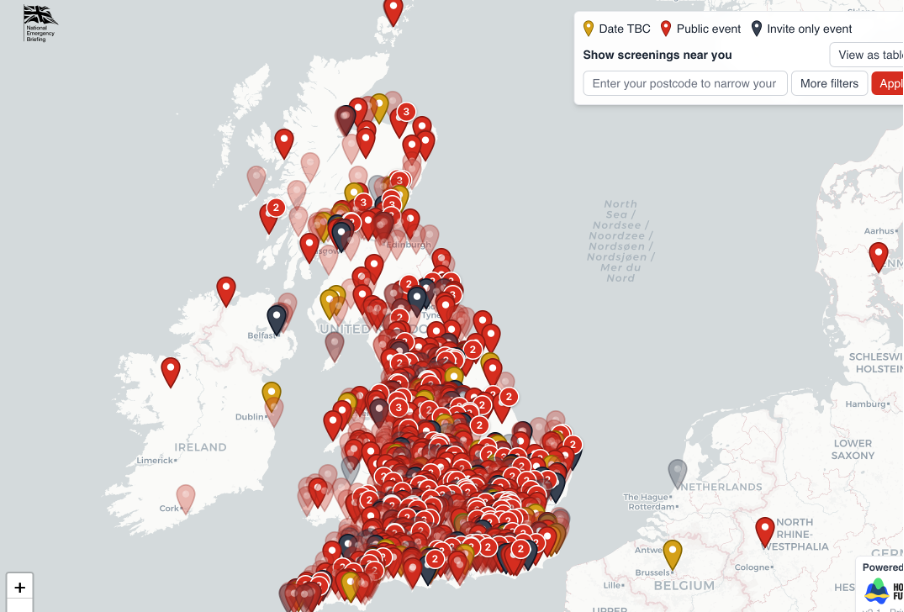
Click on the map to see the locations or find a screening near you
Knepp Rewilding Project | Monthly News
Derek Prior
Derek enthusiastically presented news updates. However, following his visit to the project, he was most keen to share the latest information about “Knepp, a trailblazing 3,500-acre rewilding project in Sussex that has changed the way we think about nature and how we can heal our planet”.
Who would not be super excited to see breeding White Storks?
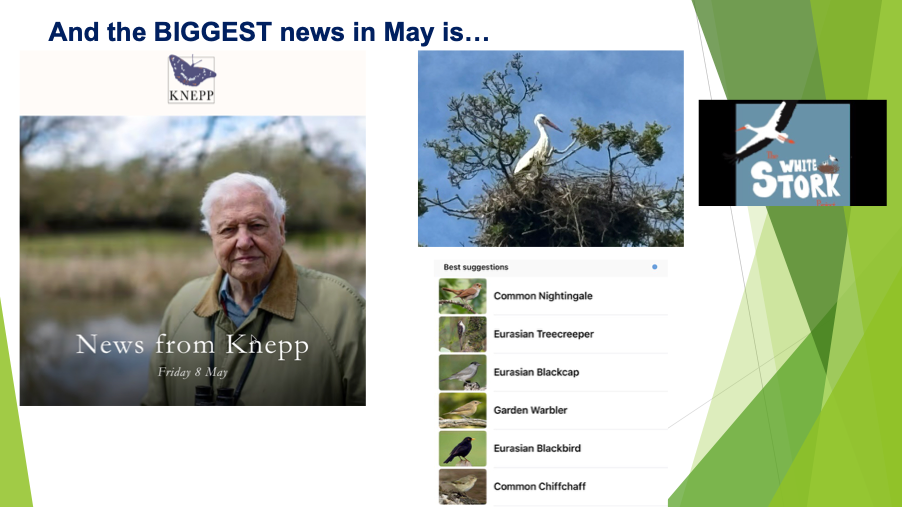
You can find out more about the project at Knepp by visiting their website
Africa – United Nations Lake Chad Project
The Environment and Climate Change group makes use of the wide variety of resources available on the internet.
Here, via YouTube, Permaculture specialise Andrew Millison celebrates the success of the United Nations project to rehydrate parts of Africa along the Great Green Wall. Of course, water knows no boundaries and the benefits of water capture and the refilling of aquifers are shared across borders.
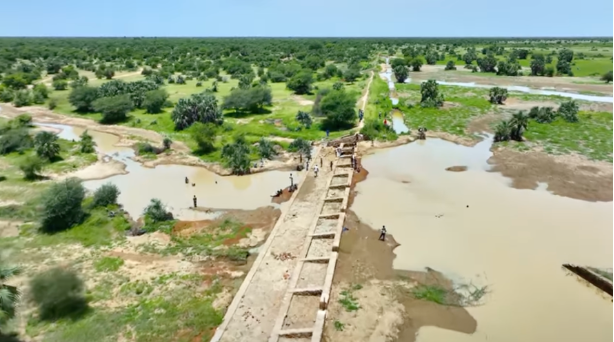
You can find out more by following this YouTube link
https://www.youtube.com/watch?v=85P5uLz3eAY&t=18s
Visit to Herriard Biodigester
Chris Griffin
How about using some anaerobic digestate soup for your evening meal? That's not as mad or bad as it sounds, because some of the recycled food processed here will ultimately become methane, burnt in two combined heat and power (CHP) units to produce electricity, which is fed into the electricity grid. Or it may be cleaned and compressed into liquid gas.
Members of the Environment & Climate Change and Science and Technology groups were shown round the Re-Gas Herriard Anaerobic Digester installation. Once acclimatised to the 'odour', we saw some of the 40,000 tons of food waste each year which is collected from the little green bins we now have being tipped into a large bin and literally screwed until it was all mashed up (and the plastic bags squeezed out). The mash is then fed into several large tanks where it is fermented under anaerobic (oxygen-free) conditions for 30-35 days. The methane generated is pumped to the CHP unit. This plant now receives most of Hampshire's domestic food waste.
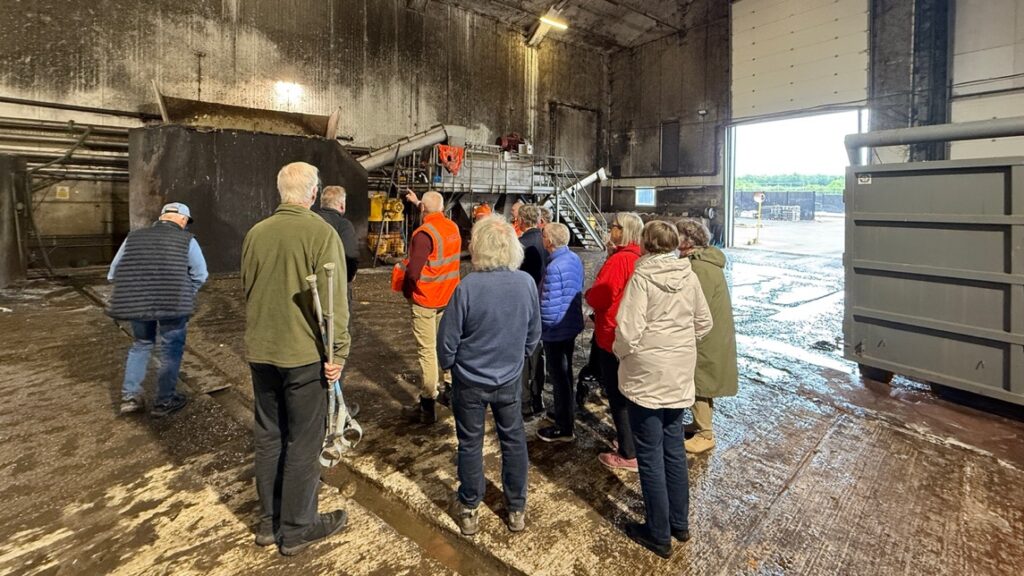
Each year 16,000 tons of maize and rye plants are also digested, the total production from all the farms of the Herriard Estate. Some of the digestate soup is sterilised by pasteurisation, then pumped into large lagoons which is then piped to the local farms as fertiliser.
Every day a large tanker conveys up to 9000m3 of sterilized compressed natural gas to a 'gas injection point' near Warwick.
Biodigesters now produce about 10% of Britain's gas production. About £35-40 million has been invested in Herriard so far, in what still counts as a minor installation. All the heat required to operate the system is generated from the process - net zero.
No gas is flared, as from most gas fields. Some CO2 is released in the process but there is a net gain. It also saves the cost of landfill. Impressive though it may seem, many European countries produce more energy from anaerobic digestion. Herriard is an excellent example of what needs to be done on a much larger scale to help green the economy and reduce the nation's carbon footprint. A very enlightening visit.
UK Offshore Gas and Oil Exploitation
Presented by Peter Fletcher & Clive Teague
The Environment and Climate Change Group has a wide range of members with a variety of skills and backgrounds including members with scientific knowledge and lengthy experience working in the Oil and Gas Industry.
The talk by Peter and Clive is extremely detailed looking at the Two Perspectives of power provision in the UK with or without fossil fuels
English Woodland and Timber Construction
Tristram Cary
New member Tristram gave a very enlightening talk entitled ‘English Woodland and Timber Construction’.
We were surprised that the UK has as little as 13% of forest woodland.
Why is UK so short of woodland?
• 3,000 bce: 60% - 80% woodland cover
• 2,000 bce: neolithic farmers cleared trees for crops and grazing (faster than Europe)
• From Tudor times Royal Navy used 2,000 to 6,000 mature oaks per warship
• Industrial Revolution used land for mines, railways, towns, farms (growing population)
• By 1919 woodland cover was 5% (its lowest point)
• Forestry Commission founded in 1919 to support woodland re-generation
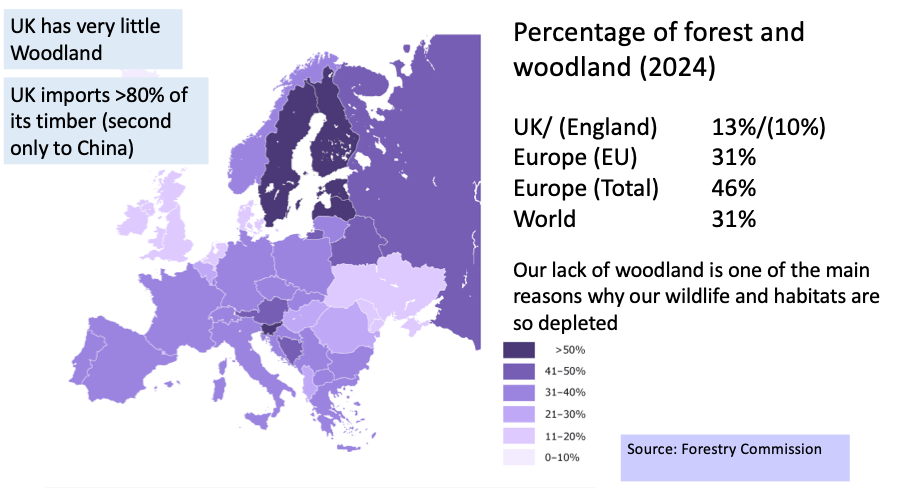
Should we be growing more trees to be used for construction? The ‘traditional’ methods of construction create massive amounts of greenhouse gasses and provide little carbon capture.
Engineered wood provides a novel and long-lasting alternative to brick and steel construction. With a flexible design it can be used to create exciting architectural living concepts.
A third aspect of investing in trees is the Woodland opportunities at Parish Level. Schemes are available to fund relatively small areas of arboricultural development, creating new plantations and subtly extending existing tree lines.
You can Explore and Discover more ……
The Environment and Climate Change Team and Speakers often carry out a considerable amount of research on behalf of the group. There is an incredible amount of information on an endless range of subjects available for FREE on the internet. Whilst we provide as much up to date information as we can, you to may wish to supplement your knowledge using these sources of news and research.
| Organisation | Website | Comment |
| 350.org UK | https://350.org/?r=GB&c=EU | UK is the regional branch of the global grassroots climate movement |
| BBC Justin Rowlatt | www.bbc.co.uk/news/topics/cn5e8npr2l3t | Justin is the BBC’s first climate editor. It’s his job to report from the front line of our changing world, documenting how global warming is reshaping ecosystems and economies. |
| BBC Science & Environment | www.bbc.co.uk/news/science_and_environment | Science and Environment focused News |
| Carbon Brief | https://www.carbonbrief.org | Free. You can subscribe to receive a daily newsletter |
| Future Earth | https://futureearth.org | Future Earth harnesses the experience and reach of thousands of scientists and innovators from across the globe. |
| MSF CharityMédecins Sans Frontières / Doctors Without Borders (MSF). | https://msf.org.uk/who-we-are | MSF is an international humanitarian organisation providing medical care in more than 75 countries. |
| Rare Earth | https://www.rareearthglobal.com | Rare Earth OS synchronises industrial demand, processing and production at scale. |
The environmental news on the RSPB, Woodland Trust, Greenpeace, Avaaz, Amnesty International, Oxfam and Reprieve are all easily found on their sites. The last five operate both nationally and internationally, as do many other bodies, including the United Nations, European Union and World Bank.
Enjoy your Environment and Climate Change travels across the internet and please do share your findings with the Odiham and District Environment and Climate Change group.
E & CC Team
2026 Monthly Meetings - January, February and March
These are some of the topics and focus issues we in our January, February and March meetings :-
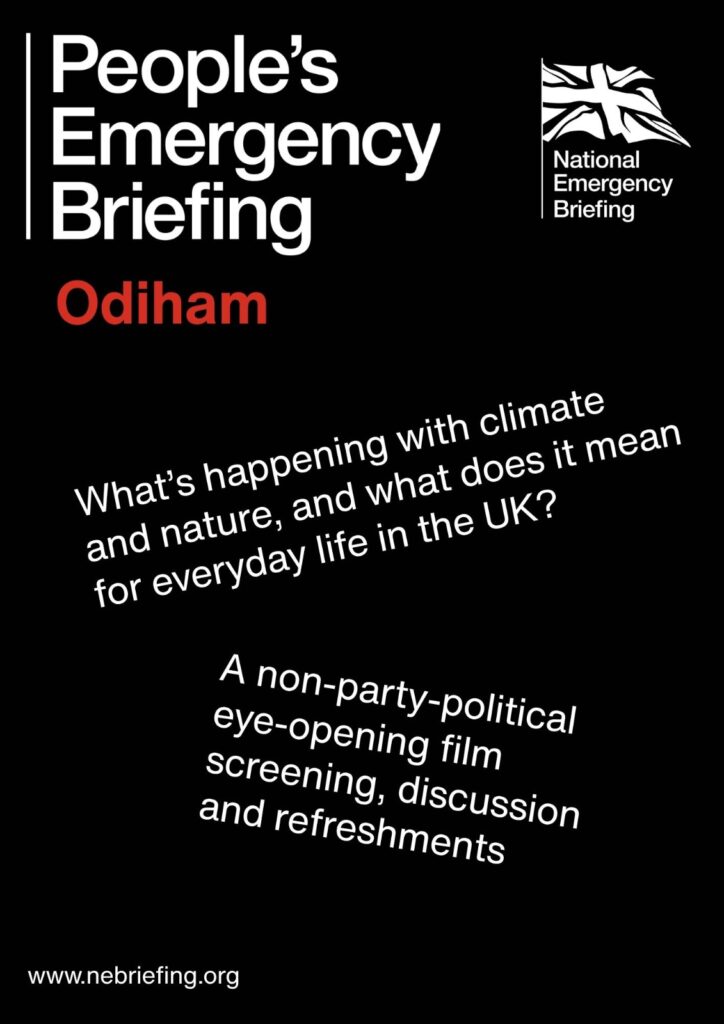
The People’s Emergency Briefing Film Screening The Cross Barn Odiham
There is a new and exciting initiative sweeping the country that aims to inform people about the climate and nature crisis while at the same time giving us agency to respond, grasping the opportunities that this crisis represents, and giving our government the mandate to act.
The film, The People’s Emergency Briefing, is followed by a facilitated and friendly discussion, over tea and cake, on the implications and opportunities for us locally.
We are screening the film twice, to give more people the opportunity to come along. The first screening on Thursday 30th April 2026 at 7pm had a capacity audience. There is a second showing:-
Sunday 31st May 2026 starting at 3pm. Entrance is free and open to everybody but please book (16+ only)
Local MPs, councillors and community leaders are being invited to attend and will be encouraged to take part in discussing how we respond as a community.
The National Emergency Briefing is supported by organisations across conservation, education, faith and civil society, including the Church of England, WWF, the National Trust, CPRE and the Royal Meteorological Society.
The film is rated as 16+ and is not therefore suitable for children.
March 2026

This month’s guest speaker Erica Evans was arranged by our group member Angela Shaw. Erica provided an informative and extremely interesting talk about the CIC Hive Helpers and their work in and around Farnham. If you would like to know more about the company and their carefully curated Farnham Bee Trail you can visit their website for more information. Here For details about the bee trail visit here
February 2026
UK High Power Prices - National Electricity Grid. Roger Booth
Our February 2026 slides include the in depth presentation by Roger who has collated his extensive research information on the subject of UK High Power Prices and how the National Electricity Grid functions.
January 2026
No more Swifts – does it matter. Derek Prior
Derek provided the group with the stark reality facing our summer visitors and how all home owners can give the Swifts a nesting opportunity so their numbers stand a chance of recovery.